Monday, March 16, 2009

Fundamentally Technical: Learning different types of Investment knowledge (pt. 2 - )


Fundamentally Technical : Part 2


In the last post I introduced the different types of trading mentalities that traders generally use to base their trading strategies/plan. The first being Fundamental which involves using the stocks values, prices/earnign ratios and other technicques that go tot he macro elements of the stock. The second form of trading psyche is Technical trading which uses price levels on the chart, volume, chart patterns and volatitily as major instruments to trade. Both forms of trading hodl their own advantages and disadvantages and both types have thier time frames that apply well for each.

For anyoen new to the trading/investment world, At first glance it might seem like a insurmountable task to attempt to wrap ones mind around all the seemingly endless amount of information one can aquire in terms of Technical analysis. I knwo when I first came into this forum of investment, I understood the underlying fundamentals of the market, The markets to trade, how to trade them, risk management, those were objective things to learn and are easily assimilated. However, one of the bigger aspects to technical trading is the use of chart patterns and volume when designing a trading strategy. Chart patterns are subjective patterns that appear on charts in any time frame, they usually take on the form and name to basic geometric shapes like triangle/pennants/cup&handles. These chart patterns also track the varitations of volume. Volume is an often mis-used tool in trading, for it holds many secrets in its use.

There are many chart patterns used in trading, but I will cover the majorly used patterns.

Symetrical Triangle:
Investopedia explains Symmetrical Triangle A symmetrical triangle is generally regarded as a period of consolidation before the price moves beyond one of the identified trendlines. A break below the lower trendline is used by technical traders to signal a move lower, while a break above the upper trendline signals the beginning of a move upward. As you can see from the chart above, technical traders use a sharp increase in volume or any other available technical indicator to confirm a breakout beyond one of the trendlines. The sharp price movement that often follows a breakout of this formation can be captured by traders who are able to identify the pattern early enough.

Ascending/Descending Triangle:
Investopedia explains Ascending Triangle An ascending triangle is generally considered to be a continuation pattern, meaning that it is usually found amid a period of consolidation within an uptrend. Once the breakout occurs, buyers will aggressively send the price of the asset higher, usually on high volume. The most common price target is generally set to be equal to the entry price plus the vertical height of the triangle. An ascending triangle is the bullish counterpart of a descending triangle.
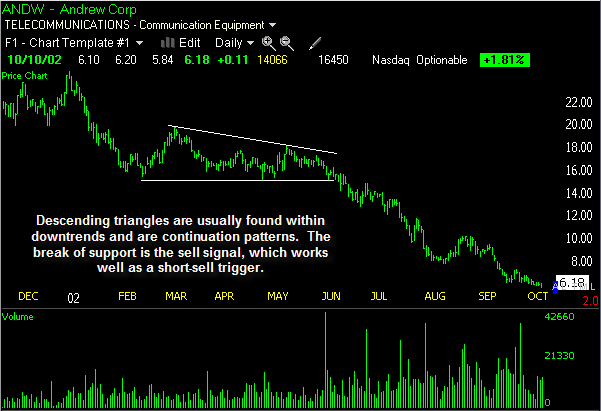
Investopedia explains Descending Triangle This is a very popular tool among traders because it clearly shows that the demand for an asset is weakening, and when the price breaks below the lower support, it is a clear indication that downside momentum is likely to continue or become stronger. Descending triangles give technical traders the opportunity to make substantial profits over a brief period of time. The most common price targets are generally set to equal the entry price minus the vertical height between the two trendlines. A descending triangle is the bearish counterpart of an ascending triangle

Head&Shoulders (Inverted):A chart pattern used in technical analysis to predict the reversal of a current downtrend. This pattern is identified when the price action of a security meets the following characteristics:

1. The price falls to a trough and then rises.
2. The price falls below the former trough and then rises again.
3. Finally, the price falls again, but not as far as the second trough.

Once the final trough is made, the price heads upward toward the resistance found near the top of the previous troughs. Investors typically enter into a long position when the price rises above the resistance of the neckline. The first and third trough are considered shoulders, and the second peak forms the head.

Flags (Pennants):


Investopedia explains Flag
Flags and pennants are among the most reliable of continuation patterns and only rarely produce a trend reversal. The only difference between the two patterns is that a flag resembles a parallelogram (or rectangle) marked by two parallel trend lines that tend to slope against the prevailing trend. The pennant, however, is identified by two converging trend lines and more horizontal which resembles a small symmetrical triangle. The important thing to remember is that they are both characterized by diminishing trade volume and though different, the measuring implications are the same for both patterns as demonstrated in the above illustration.

--------------------------------------------------

Volume :

What Does Volume Mean?
The number of shares or contracts traded in a security or an entire market during a given period of time. It is simply the amount of shares that trade hands from sellers to buyers as a measure of activity. If a buyer of a stock purchases 100 shares from a seller, then the volume for that period increases by 100 shares based on that transaction.

Investopedia explains Volume
Volume is an important indicator in technical analysis as it is used to measure the worth of a market move. If the markets have made strong price move either up or down the perceived strength of that move depends on the volume for that period. The higher the volume during that price move the more significant the move.

--------------------------------------------

Thank you for your time and happy trading

Derek 'Daizon' Clyke

Vision Wealth Management

Important Disclaimer! This website is for entertainment/educational purposes only. Equities, Futures, Options, and Currency Trading have large potential rewards, but also large potential risk. You must be aware of the risks and be willing to accept them in order to invest in the futures and options markets. Absolutely do not trade with money you can't afford to lose. This website is neither a solicitation nor an offer to Buy/Sell equities, futures or options. No representation is being made that any account will or is likely to achieve profits or losses similar to those discussed in this website. The past performance of any trading system or methodology is not necessarily indicative of future results. Absolutely consult your Registered Financial Advisor and your Risk Trading Plan before ever investing or trading any financial instrument!

Some information used in this blog comes from Investopedia.com. All information/images used here are solely for educational purposes.

Tuesday, March 3, 2009

Fundamentally Technical: Learning different types of Investment knowledge


In the investment forum there are generally two different but both important sects of traders. The first are macro in their perspective and base their trading on FUNDAMENTALS. The other side of the fence is what you would call a technically based trader who uses TECHNICALS to base their strategies. Each of these forms of trading has it's use, the key is to harness a bit of both regardless of how you trade to gain the best understanding. What I will discuss in this essay is the differences between: Fundamental & Technical analysis approached trading. Also how I use both of these forms of trading knowledge to help better my personal skill & experience by becoming what I've coined: Fundamentally Technical.

Let's get the ball rolling by discussing the most basic form of investment evaluation/analysis: Fundamental. This is the form many brokers/professionals use to valuate the stocks they are using for their clients or trying to sell to such clients. There is a lot of number data and math used in Fundamental analysis. For ease of explanation I'm going to use Investopedia (a site dedicated to investment knowledge) to help me explain Fundamental Analysis:

Investopedia explains Fundamental Analysis Fundamental analysis is about using real data to evaluate a security's value. Although most analysts use fundamental analysis to value stocks, this method of valuation can be used for just about any type of security. For example, an investor can perform fundamental analysis on a bond's value by looking at economic factors, such as interest rates and the overall state of the economy, and information about the bond issuer, such as potential changes in credit ratings. For assessing stocks, this method uses revenues, earnings, future growth, return on equity, profit margins and other data to determine a company's underlying value and potential for future growth. In terms of stocks, fundamental analysis focuses on the financial statements of a the company being evaluated.

I think that sums it up well, Here is an image of some of the Fundamental analysis data one could use. (Click to view full image)One last aspect of Fundamental analysis is Phase 1 + 2 scores as seen on the image but ill blow it up more for you here:

Phase 2 is seen as the more serious of the two phase scores to get a grasp of, What it does is list 5 major fundamental basics and attaches them a rating from 1/5. Through these ratings a final rating is given for the Phase 2, called the Phase 2 Score.
____________________________________ ____________________________________

So if Fundamental analysis is the study of the value, P/E (Price/Earnings) ratio, money coming in and Phase scores, then the opposite of all the fundamentals would be the study of the price patterns/charts or as its more commonly refereed to, Technical Analysis.

Technical analysis can be the active traders best friend if used properly to the strategy and trading rules each trader sets up for themselves. The most popular form of technical analysis I've personally come across is Price Patterns. But before I get into the specifics I'll let Investopedia help explain what Tech Analysis is:
"What Does Technical Analysis Mean?
A method of evaluating securities by analyzing statistics generated by market activity, such as past prices and volume. Technical analysts do not attempt to measure a security's intrinsic value, but instead use charts and other tools to identify patterns that can suggest future activity.

Investopedia explains Technical Analysis
Technical analysts believe that the historical performance of stocks and markets are indications of future performance.

In a shopping mall, a fundamental analyst would go to each store, study the product that was being sold, and then decide whether to buy it or not. By contrast, a technical analyst would sit on a bench in the mall and watch people go into the stores. Disregarding the intrinsic value of the products in the store, his or her decision would be based on the patterns or activity of people going into each store."

Now back to my regularly scheduled blog, tech analysis often carries a maxim by many traders "The Trend is your friend" which is often misunderstood, but loosely implies if the trend is bullish, don't try to short it (sell it) without ample reason saying that trend will stop. Technical analysis uses chart/price patterns, volume, trends, and a whole bevy of other tools to try to get an idea of what could happen next.

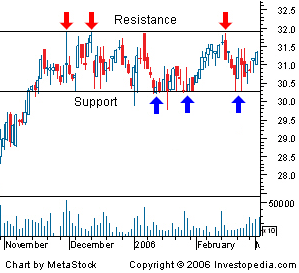
One important part of technical analysis is something called Support & Resistance. Loosely put Support is an area where a given stock finds enough demand to keep it from falling further down, and on the other side of the spectrum, Resistance is an area where the price action is met with supply and does not move any higher without provocation on either side.

Here is an image from Ivestopedia.com that excellently illustrates Support and Resistance


This bout wraps up this part of Fundamentally Technical. Pt 2 will explore chart/price patterns. Volume and how to wrap up fundamental and technical analysis and use both to help your investing.

Thank you for your time and happy trading

Derek 'Daizon' Clyke

Vision Wealth Management

Important Disclaimer! This website is for entertainment/educational purposes only. Equities, Futures, Options, and Currency Trading have large potential rewards, but also large potential risk. You must be aware of the risks and be willing to accept them in order to invest in the futures and options markets. Absolutely do not trade with money you can't afford to lose. This website is neither a solicitation nor an offer to Buy/Sell equities, futures or options. No representation is being made that any account will or is likely to achieve profits or losses similar to those discussed in this website. The past performance of any trading system or methodology is not necessarily indicative of future results. Absolutely consult your Registered Financial Advisor and your Risk Trading Plan before ever investing or trading any financial instrument!


Some information used in this blog comes from Investopedia.com. All information/images used here are solely for educational purposes.


Thursday, February 26, 2009

Chose Your Sword: Finding the best Market to trade (and how to trade them)


Chose Your Sword: Finding the best Market to trade (and how to trade them)

After you've looked over what kind of time frame you'd feel most comfortable trading in, the next big step is figuring out which market to trade. Over the past couple of decades, many markets that were previously unavailable for the common trader to trade have opened their doors to all traders. Options have become a popular way to trade moves in stock prices by using a decided strike price and premium to pay based on controlling (but not owning) 100 shares of stock. Options have Calls (for bullish) and Puts (for bearish) and in each Call/Put you have the "Bid and Ask" to be a buyer you would only use the Ask to enter trades. Futures are also a fairly new way to trade for an active trader as they trade almost 24 hours a day and are used to gauge intraday market fluctuations. The Forex (Foreign Exchange) is the trading of currency, this is the largest market in the world and with it comes a whole new and different approach than that of trading equity (stocks). Lastly we have plain stock and ETF's which stand for Exchange Traded fund, which basically means its a diversified group of stocks placed into one Ticker; this has become one of the easiest ways to diversify ones account without having to expose yourself to some of the volatile aspects of owning plain stocks.

Types of Markets:

  • Plain Stock / Equity
  • ETF's (Exchange Traded Funds)
  • Stock OPTIONS (Not available on all stocks)
  • The Futures market
  • Forex (Foreign Exchange / Currency)

This list above lists the different basic sectors of markets one can trade today. From top to bottom I would also have to say that the amount of knowledge/education/experience needed for each one follows down the same line. If your interested in trading options i would suggest that you at least have traded some stock and have a decent understanding of how they work before taking on Options (or any of the others). This isn't meant to scare people away from the different forms of trading, It's more of a warning to know what your trading - before you trade it. The best thing about trading is that you can make a living just implementing one trading strategy on one market.

------------------------------------------------

How to trade each market:

Bid (Selling Price) / Ask (Buying Price)

With plain equity/stocks, trading is done in the simple Bid (Sell Price) / Ask (Buy Price). If you are looking at a chart of XYZ (just an example) and are Bullish (think that the trend will continue up) then when you see the right moment you would click the ASK button and buy some shares. If one was Bearish (think the trend will break down lower) then one would want to short the stock by clicking the BID button. Usually there is a spread between these two prices for example: Bid 45.50 Ask 45.55, this spread between the prices should always be looked at, especially with options as sometimes the Market Makers (people putting the trades through) will pump those spreads up to make the difference. Once in a trade, either short or long, one exits a trade using the opposite form they got into the trade with, ex: if you got long at 70, and want to close it, you would click the Bid to sell it. The simple Bid/Ask system works on all forms of markets however, the way each market trades is different.

With Options there is the Bid and Ask price, but that's about the only similarities they share with regular equity. With Options you pay less than owning the stock, but you have a time limit and are at risk to swings in volatility Options work sort of like an insurance policy on your home. Many times they are used for 'insurance' on your owned Stock. For example if you bought a home for 150,000 and bought a insurance policy on your home, You pay a premium for that protection. An Option works in the same way, You chose a strike price (a price at which you may buy the stock at no matter what the stocks price is at) and pay a premium to receive the stock at that price. When you buy an option you pay the premium for contract (x100 shares of stock = premium is 4.5x100 = 450 premium) The premium is made up of two parts: 1) Intrinsic or how much over your strike price is the stock price (if the strike is 45 and the stock is at 47.5, you have $2.5 intrinsic value on your option premium. 2) Extrinsic or Time Value, this is the amount of your premium your paying for Time, which is always fading away the minute you buy it. Also with options one can be the buyer or seller of an options but that I will get into more later.

Moving on to the Futures markets which are very similar to Stocks with the only major difference being in the hours they trade, and the way that they move. Futures are the markets version of a 24/7 convenience store. Always open, and always telling us something. Many people have flocked to the futures markets, but before one wishes to trade these please understand the risks involved. First, futures trade on Margin (meaning that to take a trade costs nothing but the transaction costs) this might sound appealing until one understands that this could carry almost unlimited risk if not traded properly. Also the futures markets all trade in different increments, for example the /ES futures (S&P500) trade in 0.25 ticks, every move up or down goes 0.25-0.50-0.75.....etc, and each tick is worth $12.5 per contract so one full point move = $50. The Dow Futures (/YM) move in 1 pt increments all worth $5...So one must first comprehend each futures unique way of movement.

Lastly is the Foreign exchange markets. These markets are truly something that helps the world spin round. They are the largest traded public market in the world and almost every currency is trade able, although there are bigger currency's that take up a lot of the volume. The Forex market is available to trade in two forms, first is the cash market (www.FOREX.COM) and second is through the CME (Chicago Mercantile Exchange) which is called the Forex Futures I believe. Also if one does not wish to take on the added risk/leverage of Forex trading, one can trade Currency related ETF's on the normal stock exchange. For any new comer to trading this would be most recommended. The Forex uses the Bid/Ask platform just like Stocks, Options and Futures with the twist that when you trade the Forex you are literally trading Money. The Bid/Ask might look something like this 1.2403 the last two digits are usually whats being traded and are called Pip's. Each Milicent equals a Pips movement and like the Forex market each pip/tick movement is worth a different amount depending on the Countries currency


I hope this long winded entry is useful, Happy Trading

-------------------------------

Important Disclaimer! This website is for entertainment/educational purposes only. Equities, Futures, Options, and Currency Trading have large potential rewards, but also large potential risk. You must be aware of the risks and be willing to accept them in order to invest in the futures and options markets. Absolutely do not trade with money you can't afford to lose. This website is neither a solicitation nor an offer to Buy/Sell equities, futures or options. No representation is being made that any account will or is likely to achieve profits or losses similar to those discussed in this website. The past performance of any trading system or methodology is not necessarily indicative of future results. Absolutely consult your Registered Financial Advisor and your Risk Trading Plan before ever investing or trading any financial instrument!


Vision Wealth Management


Wednesday, February 25, 2009

Pick Your Time Frame: What kind of Trader are you?


In my opinion, for what it's worth, one of the most important things to establish when entering the world of investment is figuring out what type of trader you are. By that I mean what kind of time frame will you feel most comfortable trading in. Many people are only used to the long term type of IRA investments, but think they might find some benefits in Swing (short term days-weeks) or someone out of college with a small bit of saving might find some benefits in trading short term options. The point is that depending on your personal and time situations you have to figure out what kind of trading will benefit your personality, it is an important step - for many may want to try day trading the Dow or S&P Futures, but can't handle the stress of the day to day ebbs and flows.

Types of trading:

CORE: Longer term (Week's to Months)
Swing: Shorter time frame (Day[s] to Weeks)
Intraday: 1) Minutes to hours
2) Ticks (scalping)


Generally there are are 3 types of trading based on two trading styles (wealth & income). People with longer term trading aspirations wont mind the day to day noise because they are looking to hold for weeks to months (Core). Also falling into the wealth generating style is Swing trading which is a popular type of trading. Swing traders are looking to hold a trade for 1day to a week maybe two. Now traders who are looking for income usually fall into Intra -day traders, which basically means they are looking to implement trades within open hours and are flat when the closing bell rings. Day trading has become a very popular type of trading as of late. There are some restrictions for day trading, the biggest is having a minimum of 25k in your account to be able to trade more than a handful of day trades a week.

Sometimes traders can have a mix of strategies and for that I would recommend separate accounts for each type of trading. For instance I have one account for day & swing trades. One for longer term minded trades. This way when you manage your trades, and use charts you don't have the confusion of time frames. One important thing to keep in mind is that each time frame requires time spent studying and practicing paper and real time. There's a saying in the markets that it will pay you back in the amount of knowledge you enter it with. Take the time to hone on your skills

I hope this is something that makes sense for people out there...
From the pen of Daiz'on end

Important Disclaimer! This website is for entertainment/educational purposes only. Equities, Futures, Options, and Currency Trading have large potential rewards, but also large potential risk. You must be aware of the risks and be willing to accept them in order to invest in the futures and options markets. Absolutely do not trade with money you can't afford to lose. This website is neither a solicitation nor an offer to Buy/Sell equities, futures or options. No representation is being made that any account will or is likely to achieve profits or losses similar to those discussed in this website. The past performance of any trading system or methodology is not necessarily indicative of future results. Absolutely consult your Registered Financial Advisor and your Risk Trading Plan before ever investing or trading any financial instrument!


Vision Wealth Management

Monday, February 23, 2009

Investment Basics for everyone else....


Part of the reason many people entrust the investment of their hard earned dollars in the hands of big money investment firms is because much of the Financial world is seen as complicated and out of the league to the everyday person. However, recently the surge of the Internet has brought investment knowledge to the hands of anyone who has a modem. Also the ease of opening and managing ones own investment accounts has opened up the world of investing to the public.

The foreign exchange markets run 24 hours a day, 5 days a week; The Futures also are open almost 24 hours a day. So investing/trading has truly transformed from a forum for the few, to a career that anyone with some cash and the willing to learn and get taken out to the woodshed a couple of times.

But beware, the world of investing can be a fruitful profession, but it isn't for everyone and it isn't something that one can open an account, place trades and expect to get rich...Quite simply it takes proactive education, will power, and a lot of practice, both paper (virtual) & real $.

The reason Ive chosen to write this blog and my original day to day blog (the Marketbeat) is because I've been in the shoes of someone who was interested in beginning a career in investing but didn't know where to start. I hope this blog can be a jump start to any out there who were like me.

Here are some links to Investing sites:

- DOW JONES -

- S&P 500 -
- NASDAQ -
- TSX -
- FOREX -

I will follow this post up this week with Pick You Time Frame: Different types of investing.

Thursday, February 12, 2009

Welcome to Marketbeat: Ebbs & Flows !!!


- Welcome to Marketbeat: Ebbs & Flows -

First off I wanna introduce myself, my name is Derek Clyke. I began studying stocks through the largest online investment education firm in 2005 looking to learn what I could about the Stock Exchange. In the years that passed I learned all I could about Stocks, Options, Futures, and even dabbled into the Foreign Exchange, I've read almost every "must read" book on trading: setups, psychology, training - You name it I read about it. One thing I learned in all those hours reading is that nothing pushes your trading to new levels other than real time trading. That is what I have addressed for the past year on my blog The Marketbeat, discussing the daily movement of the major US exchanges, closing numbers, and market internals, capped off with ideas to practice with. During the time writing those blogs I realize that I could be alienating a whole area of my audience because a lot of people might not know what the Breadth is, or what a +1000 $TICK reading can mean. So this is what I hope to accomplish with Marketbeat Ebbs & Flows, I plan on bringing things I have learned in my time trading in this market in a easy to read and apply fashion.

I thank everyone who takes the time to read this blog, and take the time to help their trading push to higher levels, Happy Trading!

Derek 'Daiz'on' Clyke
Vision Wealth Management