
In the investment forum there are generally two different but both important sects of traders. The first are macro in their perspective and base their trading on FUNDAMENTALS. The other side of the fence is what you would call a technically based trader who uses TECHNICALS to base their strategies. Each of these forms of trading has it's use, the key is to harness a bit of both regardless of how you trade to gain the best understanding. What I will discuss in this essay is the differences between: Fundamental & Technical analysis approached trading. Also how I use both of these forms of trading knowledge to help better my personal skill & experience by becoming what I've coined: Fundamentally Technical.
Let's get the ball rolling by discussing the most basic form of investment evaluation/analysis: Fundamental. This is the form many brokers/professionals use to valuate the stocks they are using for their clients or trying to sell to such clients. There is a lot of number data and math used in Fundamental analysis. For ease of explanation I'm going to use Investopedia (a site dedicated to investment knowledge) to help me explain Fundamental Analysis:
Investopedia explains Fundamental Analysis Fundamental analysis is about using real data to evaluate a security's value. Although most analysts use fundamental analysis to value stocks, this method of valuation can be used for just about any type of security. For example, an investor can perform fundamental analysis on a bond's value by looking at economic factors, such as interest rates and the overall state of the economy, and information about the bond issuer, such as potential changes in credit ratings. For assessing stocks, this method uses revenues, earnings, future growth, return on equity, profit margins and other data to determine a company's underlying value and potential for future growth. In terms of stocks, fundamental analysis focuses on the financial statements of a the company being evaluated.
I think that sums it up well, Here is an image of some of the Fundamental analysis data one could use. (Click to view full image) One last aspect of Fundamental analysis is Phase 1 + 2 scores as seen on the image but ill blow it up more for you here:

Phase 2 is seen as the more serious of the two phase scores to get a grasp of, What it does is list 5 major fundamental basics and attaches them a rating from 1/5. Through these ratings a final rating is given for the Phase 2, called the Phase 2 Score.
____________________________________ ____________________________________
So if Fundamental analysis is the study of the value, P/E (Price/Earnings) ratio, money coming in and Phase scores, then the opposite of all the fundamentals would be the study of the price patterns/charts or as its more commonly refereed to, Technical Analysis.
Technical analysis can be the active traders best friend if used properly to the strategy and trading rules each trader sets up for themselves. The most popular form of technical analysis I've personally come across is Price Patterns. But before I get into the specifics I'll let Investopedia help explain what Tech Analysis is:
Now back to my regularly scheduled blog, tech analysis often carries a maxim by many traders "The Trend is your friend" which is often misunderstood, but loosely implies if the trend is bullish, don't try to short it (sell it) without ample reason saying that trend will stop. Technical analysis uses chart/price patterns, volume, trends, and a whole bevy of other tools to try to get an idea of what could happen next.
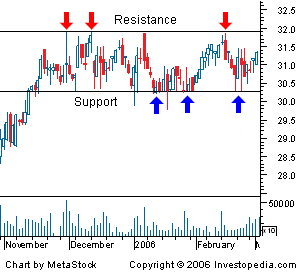
One important part of technical analysis is something called Support & Resistance. Loosely put Support is an area where a given stock finds enough demand to keep it from falling further down, and on the other side of the spectrum, Resistance is an area where the price action is met with supply and does not move any higher without provocation on either side.
Here is an image from Ivestopedia.com that excellently illustrates Support and Resistance
This bout wraps up this part of Fundamentally Technical. Pt 2 will explore chart/price patterns. Volume and how to wrap up fundamental and technical analysis and use both to help your investing.
Thank you for your time and happy trading
Derek 'Daizon' Clyke
Vision Wealth Management
Important Disclaimer! This website is for entertainment/educational purposes only. Equities, Futures, Options, and Currency Trading have large potential rewards, but also large potential risk. You must be aware of the risks and be willing to accept them in order to invest in the futures and options markets. Absolutely do not trade with money you can't afford to lose. This website is neither a solicitation nor an offer to Buy/Sell equities, futures or options. No representation is being made that any account will or is likely to achieve profits or losses similar to those discussed in this website. The past performance of any trading system or methodology is not necessarily indicative of future results. Absolutely consult your Registered Financial Advisor and your Risk Trading Plan before ever investing or trading any financial instrument!
Some information used in this blog comes from Investopedia.com. All information/images used here are solely for educational purposes.
Let's get the ball rolling by discussing the most basic form of investment evaluation/analysis: Fundamental. This is the form many brokers/professionals use to valuate the stocks they are using for their clients or trying to sell to such clients. There is a lot of number data and math used in Fundamental analysis. For ease of explanation I'm going to use Investopedia (a site dedicated to investment knowledge) to help me explain Fundamental Analysis:
Investopedia explains Fundamental Analysis Fundamental analysis is about using real data to evaluate a security's value. Although most analysts use fundamental analysis to value stocks, this method of valuation can be used for just about any type of security. For example, an investor can perform fundamental analysis on a bond's value by looking at economic factors, such as interest rates and the overall state of the economy, and information about the bond issuer, such as potential changes in credit ratings. For assessing stocks, this method uses revenues, earnings, future growth, return on equity, profit margins and other data to determine a company's underlying value and potential for future growth. In terms of stocks, fundamental analysis focuses on the financial statements of a the company being evaluated.
I think that sums it up well, Here is an image of some of the Fundamental analysis data one could use. (Click to view full image)
One last aspect of Fundamental analysis is Phase 1 + 2 scores as seen on the image but ill blow it up more for you here:Phase 2 is seen as the more serious of the two phase scores to get a grasp of, What it does is list 5 major fundamental basics and attaches them a rating from 1/5. Through these ratings a final rating is given for the Phase 2, called the Phase 2 Score.
____________________________________ ____________________________________
So if Fundamental analysis is the study of the value, P/E (Price/Earnings) ratio, money coming in and Phase scores, then the opposite of all the fundamentals would be the study of the price patterns/charts or as its more commonly refereed to, Technical Analysis.
Technical analysis can be the active traders best friend if used properly to the strategy and trading rules each trader sets up for themselves. The most popular form of technical analysis I've personally come across is Price Patterns. But before I get into the specifics I'll let Investopedia help explain what Tech Analysis is:
"What Does Technical Analysis Mean?
A method of evaluating securities by analyzing statistics generated by market activity, such as past prices and volume. Technical analysts do not attempt to measure a security's intrinsic value, but instead use charts and other tools to identify patterns that can suggest future activity.
A method of evaluating securities by analyzing statistics generated by market activity, such as past prices and volume. Technical analysts do not attempt to measure a security's intrinsic value, but instead use charts and other tools to identify patterns that can suggest future activity.
Investopedia explains Technical Analysis
Technical analysts believe that the historical performance of stocks and markets are indications of future performance.
In a shopping mall, a fundamental analyst would go to each store, study the product that was being sold, and then decide whether to buy it or not. By contrast, a technical analyst would sit on a bench in the mall and watch people go into the stores. Disregarding the intrinsic value of the products in the store, his or her decision would be based on the patterns or activity of people going into each store."
Technical analysts believe that the historical performance of stocks and markets are indications of future performance.
In a shopping mall, a fundamental analyst would go to each store, study the product that was being sold, and then decide whether to buy it or not. By contrast, a technical analyst would sit on a bench in the mall and watch people go into the stores. Disregarding the intrinsic value of the products in the store, his or her decision would be based on the patterns or activity of people going into each store."
Now back to my regularly scheduled blog, tech analysis often carries a maxim by many traders "The Trend is your friend" which is often misunderstood, but loosely implies if the trend is bullish, don't try to short it (sell it) without ample reason saying that trend will stop. Technical analysis uses chart/price patterns, volume, trends, and a whole bevy of other tools to try to get an idea of what could happen next.
One important part of technical analysis is something called Support & Resistance. Loosely put Support is an area where a given stock finds enough demand to keep it from falling further down, and on the other side of the spectrum, Resistance is an area where the price action is met with supply and does not move any higher without provocation on either side.
Here is an image from Ivestopedia.com that excellently illustrates Support and Resistance
This bout wraps up this part of Fundamentally Technical. Pt 2 will explore chart/price patterns. Volume and how to wrap up fundamental and technical analysis and use both to help your investing.
Thank you for your time and happy trading
Derek 'Daizon' Clyke
Vision Wealth Management
Important Disclaimer! This website is for entertainment/educational purposes only. Equities, Futures, Options, and Currency Trading have large potential rewards, but also large potential risk. You must be aware of the risks and be willing to accept them in order to invest in the futures and options markets. Absolutely do not trade with money you can't afford to lose. This website is neither a solicitation nor an offer to Buy/Sell equities, futures or options. No representation is being made that any account will or is likely to achieve profits or losses similar to those discussed in this website. The past performance of any trading system or methodology is not necessarily indicative of future results. Absolutely consult your Registered Financial Advisor and your Risk Trading Plan before ever investing or trading any financial instrument!
Some information used in this blog comes from Investopedia.com. All information/images used here are solely for educational purposes.


No comments:
Post a Comment