
Fundamentally Technical : Part 2
In the last post I introduced the different types of trading mentalities that traders generally use to base their trading strategies/plan. The first being Fundamental which involves using the stocks values, prices/earnign ratios and other technicques that go tot he macro elements of the stock. The second form of trading psyche is Technical trading which uses price levels on the chart, volume, chart patterns and volatitily as major instruments to trade. Both forms of trading hodl their own advantages and disadvantages and both types have thier time frames that apply well for each.
For anyoen new to the trading/investment world, At first glance it might seem like a insurmountable task to attempt to wrap ones mind around all the seemingly endless amount of information one can aquire in terms of Technical analysis. I knwo when I first came into this forum of investment, I understood the underlying fundamentals of the market, The markets to trade, how to trade them, risk management, those were objective things to learn and are easily assimilated. However, one of the bigger aspects to technical trading is the use of chart patterns and volume when designing a trading strategy. Chart patterns are subjective patterns that appear on charts in any time frame, they usually take on the form and name to basic geometric shapes like triangle/pennants/cup&handles. These chart patterns also track the varitations of volume. Volume is an often mis-used tool in trading, for it holds many secrets in its use.
There are many chart patterns used in trading, but I will cover the majorly used patterns.
Symetrical Triangle:
 Investopedia explains Symmetrical Triangle A symmetrical triangle is generally regarded as a period of consolidation before the price moves beyond one of the identified trendlines. A break below the lower trendline is used by technical traders to signal a move lower, while a break above the upper trendline signals the beginning of a move upward. As you can see from the chart above, technical traders use a sharp increase in volume or any other available technical indicator to confirm a breakout beyond one of the trendlines. The sharp price movement that often follows a breakout of this formation can be captured by traders who are able to identify the pattern early enough.
Ascending/Descending Triangle:
 Investopedia explains Ascending Triangle An ascending triangle is generally considered to be a continuation pattern, meaning that it is usually found amid a period of consolidation within an uptrend. Once the breakout occurs, buyers will aggressively send the price of the asset higher, usually on high volume. The most common price target is generally set to be equal to the entry price plus the vertical height of the triangle. An ascending triangle is the bullish counterpart of a descending triangle.
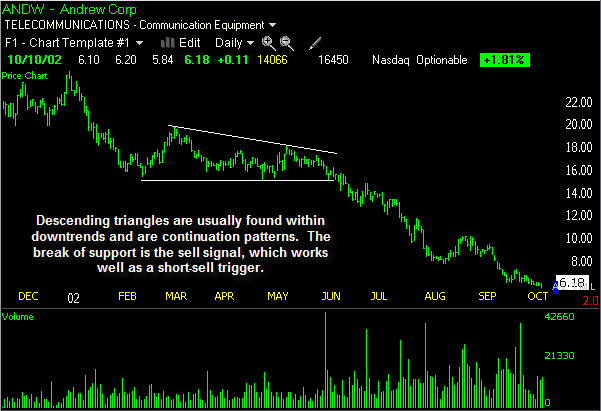 Investopedia explains Descending Triangle This is a very popular tool among traders because it clearly shows that the demand for an asset is weakening, and when the price breaks below the lower support, it is a clear indication that downside momentum is likely to continue or become stronger. Descending triangles give technical traders the opportunity to make substantial profits over a brief period of time. The most common price targets are generally set to equal the entry price minus the vertical height between the two trendlines. A descending triangle is the bearish counterpart of an ascending triangle
Head&Shoulders (Inverted):


 A chart pattern used in technical analysis to predict the reversal of a current downtrend. This pattern is identified when the price action of a security meets the following characteristics:
 1. The price falls to a trough and then rises.
2. The price falls below the former trough and then rises again.
3. Finally, the price falls again, but not as far as the second trough.
Once the final trough is made, the price heads upward toward the resistance found near the top of the previous troughs. Investors typically enter into a long position when the price rises above the resistance of the neckline. The first and third trough are considered shoulders, and the second peak forms the head.
Flags (Pennants):

Investopedia explains Flag
Flags and pennants are among the most reliable of continuation patterns and only rarely produce a trend reversal. The only difference between the two patterns is that a flag resembles a parallelogram (or rectangle) marked by two parallel trend lines that tend to slope against the prevailing trend. The pennant, however, is identified by two converging trend lines and more horizontal which resembles a small symmetrical triangle. The important thing to remember is that they are both characterized by diminishing trade volume and though different, the measuring implications are the same for both patterns as demonstrated in the above illustration.
--------------------------------------------------
Volume :
What Does Volume Mean?
The number of shares or contracts traded in a security or an entire market during a given period of time. It is simply the amount of shares that trade hands from sellers to buyers as a measure of activity. If a buyer of a stock purchases 100 shares from a seller, then the volume for that period increases by 100 shares based on that transaction.
Investopedia explains Volume
Volume is an important indicator in technical analysis as it is used to measure the worth of a market move. If the markets have made strong price move either up or down the perceived strength of that move depends on the volume for that period. The higher the volume during that price move the more significant the move.
--------------------------------------------
Thank you for your time and happy trading
Derek 'Daizon' Clyke
Vision Wealth Management
Important Disclaimer! This website is for entertainment/educational purposes only. Equities, Futures, Options, and Currency Trading have large potential rewards, but also large potential risk. You must be aware of the risks and be willing to accept them in order to invest in the futures and options markets. Absolutely do not trade with money you can't afford to lose. This website is neither a solicitation nor an offer to Buy/Sell equities, futures or options. No representation is being made that any account will or is likely to achieve profits or losses similar to those discussed in this website. The past performance of any trading system or methodology is not necessarily indicative of future results. Absolutely consult your Registered Financial Advisor and your Risk Trading Plan before ever investing or trading any financial instrument!
Some information used in this blog comes from Investopedia.com. All information/images used here are solely for educational purposes.


No comments:
Post a Comment